
Borobudur Stupa Interior: Understanding the Sacred Stupas
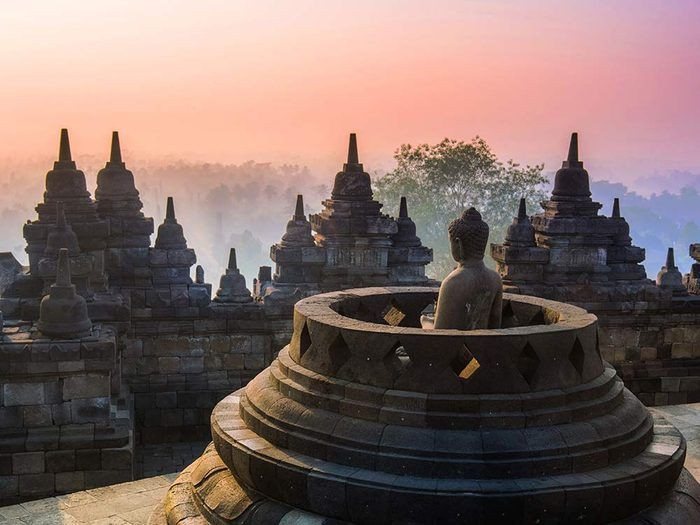
When exploring Borobudur stupa interior, many visitors expect to find rooms or chambers inside the monument. However, Borobudur has a different architectural concept. Its stupas are mainly solid stone structures designed as important elements of the temple’s Buddhist symbolism. Understanding their construction helps visitors appreciate the monument beyond its impressive exterior.
Understanding the Stupas of Borobudur
Borobudur features numerous stupas across its upper circular terraces. These structures become especially prominent as visitors move upward from the square levels toward the circular platforms. Their repeated forms create a distinctive architectural pattern while representing important ideas within Buddhist teachings.
The largest stupa stands at the center of the highest platform. Unlike the surrounding perforated stupas, the central stupa does not contain a visible Buddha statue. Its simple and closed appearance creates a strong contrast with the detailed reliefs found on the lower levels.
Visitors interested in the subject can learn more through this Borobudur inside guide, which explains the monument’s structure, reliefs, and spiritual meaning.
Are Borobudur Stupas Hollow Inside?
The question of whether the stupas are hollow often appears when discussing Borobudur stupa interior. The perforated stupas on the circular terraces are not conventional rooms that visitors can enter. They are constructed around Buddha statues, with the lattice-like stone design allowing the statues to be partially visible from outside.
The Buddha figures inside these stupas sit in different symbolic positions. Their placement contributes to the spiritual character of the upper terraces and creates an experience that changes as visitors walk around the monument.
Because the structures are not designed as accessible chambers, visitors normally experience them from the outside. Their meaning comes from the relationship between the Buddha statues, the surrounding stupas, and the overall design of Borobudur.
Architecture and Buddhist Symbolism
The arrangement of the stupas is closely connected with Borobudur’s broader architectural concept. The monument consists of square terraces below and circular platforms above. This transition creates a movement from highly decorated areas toward simpler architectural forms.
The lower terraces contain extensive relief panels that depict Buddhist teachings, stories, and scenes from ancient life. As visitors reach the circular levels, the visual environment becomes less decorative. The repeated stupas and open surroundings create a more contemplative atmosphere.
This architectural progression is one reason why the upper section is essential when studying Borobudur. The stupas are not simply decorative features. They form part of a carefully planned structure that expresses Buddhist concepts through architecture.
Exploring Borobudur’s Upper Terraces
A visit to Borobudur becomes more meaningful when travelers understand what they are seeing. Instead of searching for a conventional interior, visitors can observe how the stupas interact with the terraces, Buddha statues, and central structure.
The perforated stupas also provide memorable views from various angles. Their geometric patterns, stone construction, and relationship with the surrounding landscape make them important photographic subjects.
Travelers who want to explore the monument and other cultural destinations in Central Java can also consider Borobudur Tours for broader travel experiences around Yogyakarta and Borobudur.
Why the Stupas Matter
The Borobudur stupa interior is best understood through the monument’s architectural and spiritual context. Rather than functioning as ordinary rooms, the stupas contribute to a sacred design centered on Buddhist symbolism and meditation.
By examining their structure, Buddha statues, perforated stone patterns, and position on the upper terraces, visitors can gain a deeper appreciation of Borobudur’s architectural complexity. The experience becomes more than viewing ancient stone structures; it becomes an opportunity to understand how architecture can communicate spiritual ideas.
